Simplifier transforms your business process into a configured business application for
- Web Portals for Desktop-Browsers
- Mobile Phones and Tablets
- Wearables Devices like Smartwatches and Glasses
Applications run on any device because it is generated on common open standard technology leveraging OpenUI5 / SAPUI5
Overview
By clicking on the Applications tile, you will be lead to the overview. At default, there you will see a table with all the created applications. Within this table, you’ll get information like the name of the app, the app’s description, created by, and last edited by.
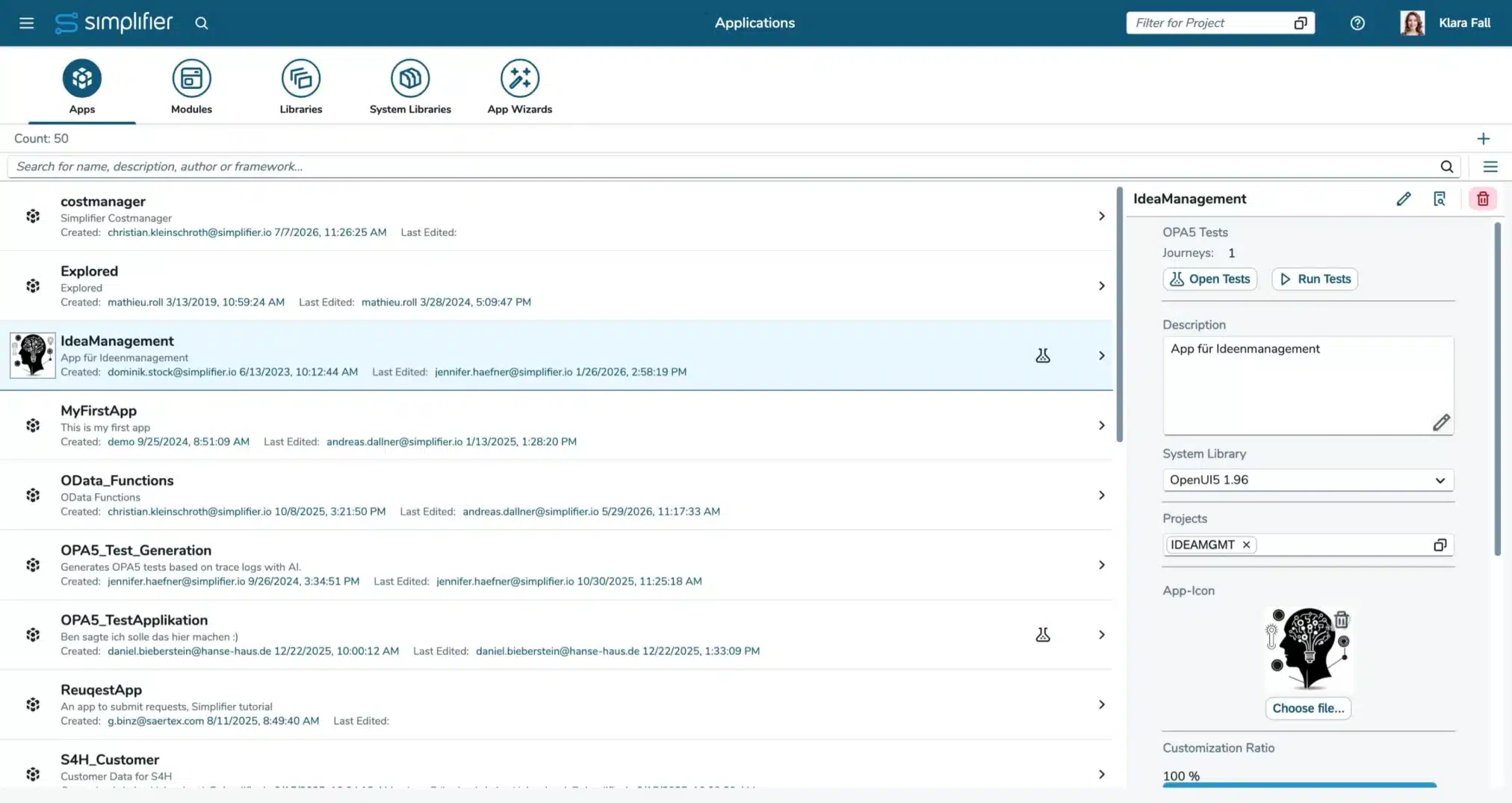
If you click on an application in the overview, further information and actions are displayed on the right side. On the one hand, you can edit the app name, switch directly to the application preview, or delete the application. On the other hand, you can customize the description, the app icon, look at the customization ratio and the version. Below this information, you then have various actions, in this case, Copy Application and Show Releases.
| App | It’s the name of the application. |
| OPA5 Tests | See how many test journeys you have already created and the last test result. Jump directly to the test creation for the application or run the application’s tests |
| Description | The application’s description. |
| System Library | The application’s system library used. |
| Projects | Assign all projects relevant for the application. |
| App Icon | Set the applications icon used for the launchpad, Mobile Client and Standalone Build Service. |
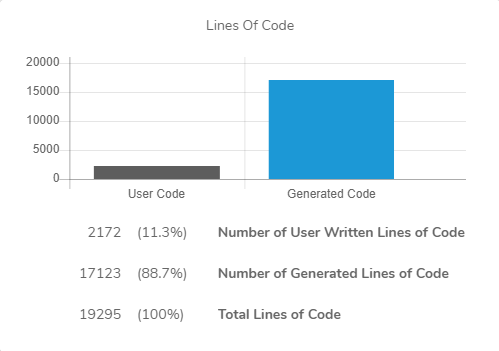
| Customization Ratio | After deploying an application, a code metric is available in the overview. It shows the generated lines of code and a comparison to the lines of code written by the customizer in events and script activities. |
| Version | The current release number of the application. |
| Generated with Simplifier | See with which Simplifier Version the application has been created |
| Generated with App Editor Version | As we have started implementing the App Building AI Agent Anna, you can see if the App is created with her or the legacy App Editor v1 |
| Actions | Edit application, Copy Application, Copy as Module, Show Releases, View Monitoring Logs, Preview, and Delete the application. |
You can hide the details on the right with the button right of the search bar.
Create a new application
When creating a new application, you can select between the legacy v1 App Editor and our experimental v2 App Editor.
The v2 Editor is based on a GIT integration and will introduce AI native app building to Simplifier.
Create your first application based on the v1 App Editor
See our Training Course Basic 100 to learn how to create a legacy application.
Create your applications based on the AI App Editor (experimental)
See our documentation on how to create applications with Anna in the AI App Editor.