Manage Templates
Within the tile for Templates, you can create templates in HTML-format.
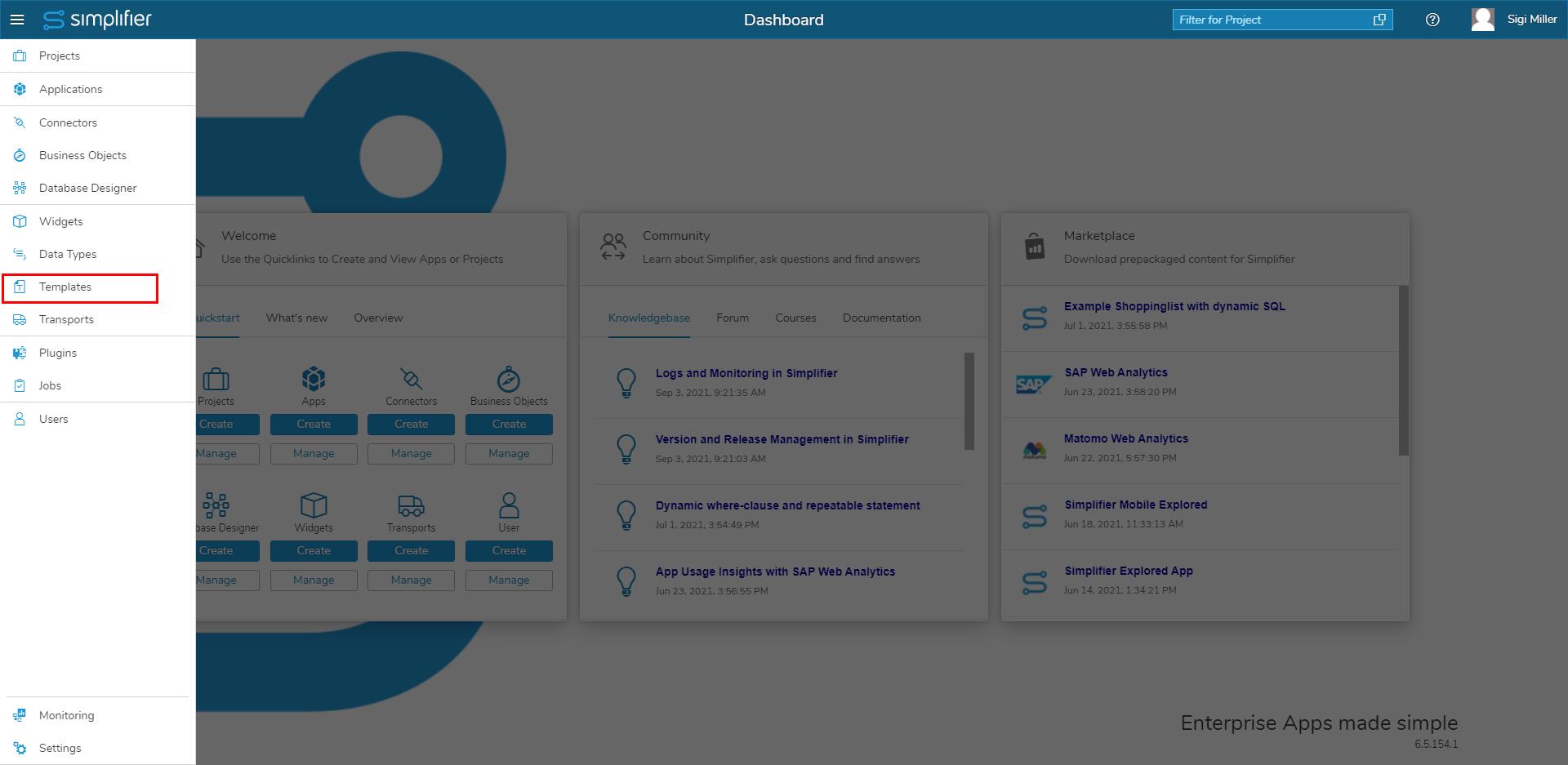
Templates are HTML templates that allow you to create and consistently use patterns.
To create a new template, click on the plus icon in the template overview. Select the folder name and enter a template name, optionally a description. Now enter the HTML template content. On the right side, you see a preview of the template. Once you have created the template content, click Save.
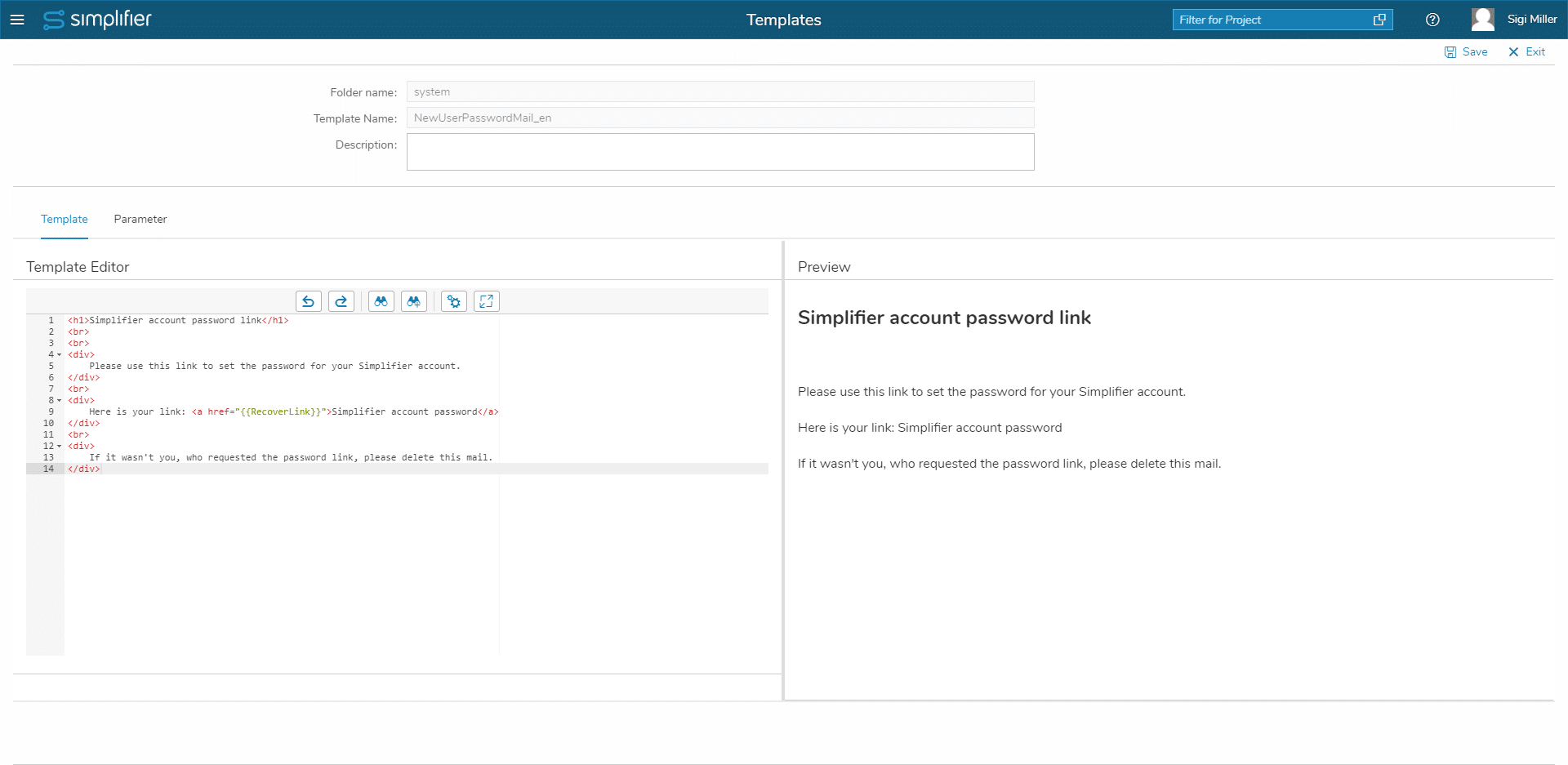
The Template Editor
In the Template Editor, you have several options in the toolbar:
- Undo
- Redo
- Search
- Search and Replace
- Settings
- Fullscreen
In addition, it is possible to parameterize templates. To do this, switch to the tab ‘Parameters’. Via the plus icon, you can add a new input parameter.
Set placeholders for parameters
Our template feature for placeholders is based on the library Handlebars, which is similar to Mustache but not the same. Basic placeholders are set via {{paramName}}.
Example for basic parameter
{{parameterName}}
Example for a struct parameter
{{structParameterName.key}}
Example for using a condition
{{#someBoolParameter}}Hello World{{/someBoolParameter}}
Example for using a loop
<table>
{{#someCollectionParameter}}
<tr>
  <td>{{param1}}</td><td>{{param2}}</td>
</tr>
{{/someCollectionParameter}}
</table>
Restrictions
There are some restrictions within Simplifier, which are documented on GitHub. E.g.:
- Paths with special characters. Example: {{foo-bar}}
- Literal Paths. Example: {{[foo bar]}}, {{[foo bar]/expression}}, {{[@alan]/expression}}
- Hashes using single quotes. Example: {{foo cruel=’CRUEL’}}
- Parameters as strings. Example: {{wycats is.a slave.driver}} – The first parameter to the wycats helper will result in the empty string, not “is.a”
New integration of the VS Code Monaco Editor (experimental)
If activated in the feature settings, the legacy code editor is replaced with the VS Code Editor Monaco. The VS Code Monaco Editor brings syntax highlighting and HTML code completion.